
Steel Bar Sizes in Kenya: D8 to D32 and What Each One Is For
The number is the bar's thickness in millimetres. Once that clicks, every steel conversation on site gets easier.
By Safeworld Steel Desk, SAFEWORLD STORES LTD
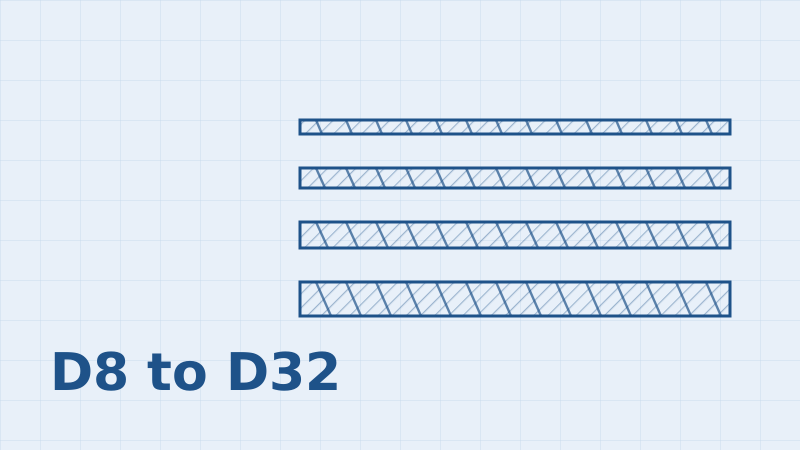
Walk into any hardware in Nairobi and ask for steel, and the first question back is "which D?" Kenyan yards name deformed bars by a D followed by the diameter in millimetres: D8 is an 8 mm bar, D12 is 12 mm, D16 is 16 mm. Your structural drawing might say T12 or Y12 instead. Those are older conventions for the same thing, a high-yield ribbed bar 12 mm across. Ask for D12 and you will get exactly what the drawing means.
Every one of these bars comes in a standard 12 m length, which older fundis still call a 40-foot bar.
What each size is normally used for
The structural drawing decides which bar goes where. Knowing roughly where each size is used helps you check an order before you pay for it.
| Bar | Typical use on Kenyan buildings | Weight of a 12 m bar |
|---|---|---|
| D8 | Rings (links/stirrups) around column and beam steel, light slab mesh | about 4.7 kg |
| D10 | Slab bars, main bars in lightly loaded columns on small houses | about 7.4 kg |
| D12 | The workhorse: slabs, beams, columns, strip foundations | about 10.7 kg |
| D16 | Ground-floor columns in storey buildings, main beam steel, bases | about 19 kg |
| D20 | Columns and beams in multi-storey frames | about 29.6 kg |
| D25 | Heavy columns, pile caps, transfer beams | about 46 kg |
| D32 | Bridges, heavy foundations, big commercial frames | about 76 kg |
Weights are the standard nominal figures (diameter² ÷ 162, in kg per metre, times 12).
Why D16 costs far more than twice a D8
Steel is sold by the bar but priced by the weight. The weight of a bar goes up with the square of its diameter, so doubling the diameter from 8 mm to 16 mm gives you four times the steel. A D16 weighs about 19 kg against a D8's 4.7 kg. So the price per bar climbs steeply as you go up the sizes, and swapping a size on the drawing changes the strength of the element far more than the small change in number suggests.
Deformed bar versus round bar
The D bars above are deformed (ribbed): the ribs rolled into the surface are what let concrete grip the steel. Plain round bar has a smooth surface and a lower grade. It is the fundi's bar for window grills and light fabrication, not for structural concrete. And twisted bars, the old square bars twisted into a spiral, have been banned in Kenya since April 2017. Don't buy them.
Which grade?
Structural bars in Kenya should meet KS EAS 412-2, which lines up with the British BS 4449 grade B500. Most mills roll a mark into the bar showing who made it, the size and the grade, for example "TNK 12 B500". Ask for the mill certificate when you order, not after delivery, so it matches the batch you actually receive.
Ordering by size
When you send an order, list it the way the drawing does: size and number of 12 m bars, e.g. "40 × D12, 25 × D8". If you only have the drawing, send that and we will count the bars for you. See the full range of steel bars we stock.
Sources: Construction Kenya, steel bar prices and uses; Tononoka Steels product catalogue; Construction Kenya on the 2017 twisted bar ban.
Quick answers
- Is Y12 the same as D12?
- Yes. Y12, T12 and D12 all mean a 12 mm high-yield deformed bar. Kenyan yards use D12.
- How long is a steel bar in Kenya?
- Deformed and round bars come in 12 m lengths, also called 40-foot bars.
- How heavy is a D12 bar?
- About 10.66 kg for a 12 m length (0.888 kg per metre).
Know the sizes you need?
Send them on WhatsApp or through the quote form and we will reply with today's price and delivery from Syokimau.